Neurodivergent Test: See Which of Ten Trait Areas Stand Out
Forty-three statements, about eight minutes, and a neurodivergent test result that shows ten trait areas side by side instead of one number. Answer for the last six months; nothing leaves your browser.
Neurodivergent traits self-check
Short statements about how you usually think, feel and move. You get a separate result for each of ten trait areas — never one overall score — and a sheet to take to your doctor.
- 43 statements
- 10 trait areas
- 5 answer steps, Never to Very often
- 0 answers sent anywhere
Time frame: think about the last 6 months, and about how you usually are — not your best or worst day.
This is a self-check for reflection, not a diagnosis or medical advice. Only a qualified professional can assess ADHD, autism, dyslexia or dyspraxia.
Last 6 months, how you usually are. Keys 1–5 answer the focused statement and move to the next one.
Since when, and how much does it get in the way?
A trait on its own is just part of how you work. What a professional looks at is whether it has been there since childhood and whether it causes real difficulty. Keys 1–3 answer the focused question.
Your trait profile
This is a self-check for reflection, not a diagnosis or medical advice. Only a qualified professional can assess ADHD, autism, dyslexia or dyspraxia.
How this is scored
- Each answer counts from 0 (Never) to 4 (Very often). Three statements are worded the other way round — “I can stay with a boring task…”, “Chatting with people I have just met…” and “Noisy, bright places…” — and count 4 minus the answer.
- Area points = the sum over the area’s statements; maximum = 4 × the number of statements. Percent = points ÷ maximum × 100, rounded half up.
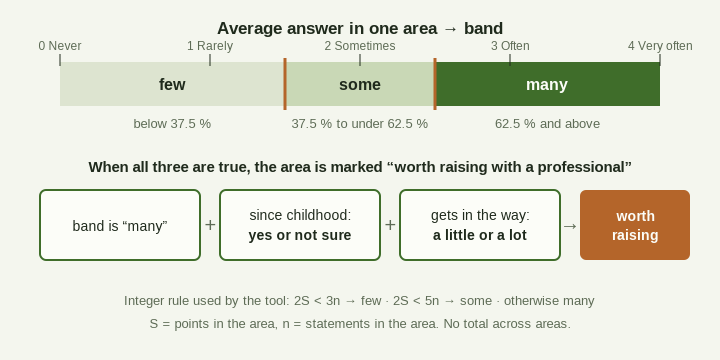
- Bands use the average per statement: below 1.5 = few traits, 1.5 up to 2.5 = some traits, 2.5 and above = many traits.
- The two follow-up questions appear only for areas with some or many traits. “Worth raising with a professional” appears when an area has many traits, it gets in the way at least a little, and the childhood answer is not “No”.
- If the same answer covers 90% or more of the statements (39 of 43), you see a note about the answer pattern.
- There is no total across areas. Ten different areas do not add up to one number.
Take it to your appointment
What to do next
- Write down real examples. For each raised area, note two or three moments from work, home or school. The sheet above has lines for them.
- Talk to your GP or doctor. Bring the sheet and ask whether a referral makes sense. Waiting times vary a lot.
- Know who assesses what. ADHD and autism are assessed by specialist teams after a referral; dyspraxia often with an occupational therapist; dyslexia by an educational psychologist or specialist assessor rather than a doctor.
If you are in crisis, contact your local emergency number or a crisis line.
Before you start the neurodivergent test
The check above has 43 short statements and takes most people about eight minutes. Each one is answered on the same five-step scale: Never, Rarely, Sometimes, Often, Very often. Think about the last six months and how you usually are, not your best week or your worst one. The adult ADHD screener built with the World Health Organization uses the same scale and the same six-month window (ASRS v1.1, PDF), and I have kept both because they make answers far more comparable. The statements come one trait area at a time with a progress line such as “Area 3 of 10”; the keys 1 to 5 answer the statement in focus and move on, and you can jump back to any area to change an answer.
My one tip before you begin: for every statement you mark Often or Very often, try to picture a real moment when it happened. If no example comes to mind, the honest answer is probably one step lower. Those examples are also what a clinician will ask you for later.
A self-check for reflection, not a diagnosis or medical advice. Only a qualified professional can assess ADHD, autism, dyslexia or dyspraxia. Your answers stay in your browser; nothing is sent to a server.
The ten trait areas and what each one covers
Each row below is scored on its own. The area names describe what you do and feel; the condition appears only as an “often linked with” note, because a handful of statements can show where to look but cannot name a condition.
| Area | What it covers | Often linked with | Statements |
|---|---|---|---|
| Attention and focus | drifting off tasks, losing things, missing details | ADHD (inattentive traits) | 5 |
| Restlessness and impulsivity | fidgeting, feeling driven, acting on impulse, interrupting | ADHD (hyperactive-impulsive traits) | 5 |
| Planning and time | starting tasks, time blindness, ordering steps, unfinished projects | ADHD, autism, dyspraxia | 4 |
| Social communication | hints, faces and tone, turn-taking, coming across as blunt | autism | 5 |
| Routines and deep interests | unexpected change, sameness, absorbing interests, calming repeated movements | autism | 4 |
| Sensory processing | sounds, light, textures, crowded places, noticing small details | autism, ADHD | 5 |
| Masking and social energy | copying others, rehearsing, recovery time after people | autism, ADHD (a coping strategy, not a condition) | 4 |
| Reading and spelling | losing your place, uneven spelling, mixing up order | dyslexia | 4 |
| Numbers and maths | mental arithmetic, swapped digits, estimating amounts | dyscalculia | 3 |
| Movement and coordination | bumping and dropping, fine motor tasks, judging space | dyspraxia (DCD) | 4 |
Three statements are worded the other way round, one each in attention, social communication and sensory processing. Answering Often to all of them on autopilot will not push every bar to the top, and if 39 or more of your 43 answers are identical, the result says so gently: at that point the profile tells you more about the scale than about you.
Reading your profile: few, some or many traits
Every area ends in one of three bands, set by your average answer in that area. Below 1.5 (between Rarely and Sometimes) is few. From 1.5 up to 2.5 is some. From 2.5 (halfway between Sometimes and Often) is many. Next to each band you also see how many statements counted as Often or Very often, which I find more telling than the percentage. The same ten numbers are drawn as a radar chart, with dashed rings at 37.5 % and 62.5 % marking the band edges, and each row below it gives the area, the points out of the maximum, the percentage, the band and a short plain-language line.
There is deliberately no overall score. Sixty per cent across the board could mean ten mildly raised areas or two very high ones, and those lead to completely different conversations. A single “how neurodivergent are you” number hides exactly the shape a professional needs to see.
Frequency alone is not enough either. The ASRS instructions tell clinicians to look at impairment at work or school, socially and in the family, and at whether problems were present in childhood (ASRS v1.1). So for every area in the some or many band you get two follow-up questions: was this also true before about age 12, and how much does it get in the way? An area is marked worth raising with a professional only when the band is many, the impact is at least “a little” and the childhood answer is not “no”. That is the line between a trait and a trait that costs you something.
Two profiles, worked through
Profile A: attention and planning stand out. The attention answers are Very often, Often, Often, Often, and Never for the reversed statement about staying with a boring task. Reversed, that Never counts as 4 − 0 = 4 points, so the area totals 4 + 3 + 3 + 3 + 4 = 17 of 20. That is 85 %, an average of 3.4, band many, with all five statements at Often or above. Planning answers of 4, 4, 3, 3 give 14 of 16 = 88 %, many. Restlessness lands at 12 of 20 = 60 % (some) and sensory at 9 of 20 = 45 % (some); everything else stays in few.
When I see a shape like this, my first question is whether the drifting and the lateness were already there at school. If the childhood answer is yes and the impact is “a lot”, attention and planning both carry the worth-raising mark. That is the pattern an ADHD assessment explores, not a finding in itself.
Profile B: sensory, masking, routines and social communication stand out. Sensory answers of 4, 4, 3, 3 and Never for “noisy, bright places do not bother me” (reversed to 4) give 18 of 20 = 90 %. Masking 3, 4, 4, 3 = 14 of 16 = 88 %. Routines 4, 3, 4, 2 = 13 of 16 = 81 %. Social communication 3, 3, 3, 2 plus a reversed Never = 15 of 20 = 75 %. Attention sits at 8 of 20 = 40 %, some.
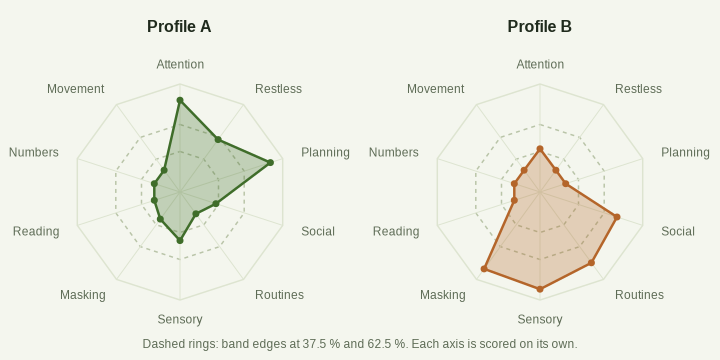
In profile B, the masking score is higher than the social score, and that is common in people who learned to compensate early: you work out the rules of conversation so well that the social statements look only moderately true, while the cost shows up as exhaustion afterwards. The NHS page on autism in adults notes that autistic women in particular may copy others and appear to cope while struggling inside. This is why I always say examples matter more than the number. “I script phone calls and need the evening alone after a team lunch” says more than 88 %.
Why several areas often rise together
Expect more than one raised area; that is the normal picture, not a sign the neurodivergent test is broken. The NHS notes that ADHD often comes with depression, anxiety, addictions or a learning difficulty such as dyslexia, and that it can occur together with autism (NHS, ADHD symptoms). Dyspraxia often co-occurs with ADHD, dyslexia, autism, anxiety and depression (NHS, dyspraxia in adults). Many autistic adults with ADHD call the combination AuDHD.
The reverse is also true. A rough patch of anxiety, low mood, poor sleep or heavy stress can raise attention, planning and sensory answers on its own. That is exactly why the childhood question exists: long-standing traits usually reach back to school years, while a reaction to a hard season usually does not. If the last six months were unusual for you, take the check again once things settle, and mention both results to whoever you see.
For a side-by-side look at how the same behaviour can come from different places, read ADHD, autism or both.
What to do with your result
A raised area is a reason for a conversation, not a label. In most places the first stop is a GP or family doctor, who decides on a referral. Who carries out the assessment depends on the area:
- Attention, restlessness, planning: a GP can refer you to a mental health professional who specialises in ADHD; waiting times vary (NHS, ADHD in adults).
- Social communication, routines, sensory, masking: a GP can refer you for an autism assessment (NHS, autism in adults).
- Movement and coordination: after the GP, usually an occupational therapist, who looks at childhood history and watches how you move (NHS, dyspraxia).
- Reading and spelling: dyslexia is assessed by an educational psychologist or specialist teacher rather than a doctor, and it is not linked to intelligence (NHS, dyslexia).
What I ask people to bring:
- The appointment sheet the tool builds: your raised areas (some or many), the statements that counted as Often or Very often with your answers, your childhood and impact answers, and three blank “Real example:” lines per area. You can print it (only the sheet is printed) or copy it as text.
- Two or three real examples per raised area, one from work or study and one from home.
- Childhood evidence: school reports, comments from teachers, what a parent or sibling remembers.
- One sentence on what you hope the appointment changes, such as support at work, an explanation, or treatment options.
A step-by-step walkthrough of referrals and what each assessment involves is in how to get assessed as an adult. If you are unsure what the words themselves cover, start with what neurodivergent means. And if you are in crisis right now, contact your local emergency number or a crisis line before anything else.
The arithmetic behind every bar
Nothing here is hidden. Each answer is worth 0 (Never) to 4 (Very often); a reversed statement counts 4 minus your answer. Per area:
S = sum of points · maximum = 4 × n · percentage = S ÷ (4 × n) × 100, rounded half up
few if 2S < 3n · some if 2S < 5n · otherwise many
Here n is the number of statements in the area (3 to 5). The bands are worked out with whole numbers, not from the rounded percentage, so a boundary case such as 10 of 16 lands in the right band every time. The statements are written for this site; they borrow the scale and time frame of the ASRS but not its wording, and this is not a validated clinical instrument. The tool's own test page checks it against fixed cases like these:
| Answers | Points | Percentage | Band |
|---|---|---|---|
| Every statement answered Never | Attention 4/20 (the reversed statement counts 4) | 20 % | few |
| Every statement answered Sometimes | Attention 10/20 | 50 % | some |
| Attention 3, 3, 2, 4 and reversed statement Rarely (counts 3); rest Rarely | Attention 15/20 | 75 % | many |
| Planning 3, 3, 2, 2 | Planning 10/16 | 63 % | many (average exactly 2.5) |
| Planning 3, 2, 2, 2 | Planning 9/16 | 56 % | some |
| Social 4 × Often, reversed statement Very often (counts 0) | Social 12/20 | 60 % | some |
| Social 4 × Often, reversed statement Never (counts 4) | Social 16/20 | 80 % | many |
| Numbers 3, 3, 2 | Numbers 8/12 | 67 % | many |
Everything runs in your browser. Answers live in memory and disappear when you close the tab, unless you tick the option to remember them on this device, which you can clear at any time.
Guides
 What does neurodivergent mean? Conditions and limitsThe three words people mix up, which conditions are usually included, who assesses each, and how to ask for what helps at work.6-minute read
 ADHD or autism? Where the traits overlap and differLeaving a party early can mean overload or restlessness. A trait-by-trait look at overlap, masking and having both.6-minute read
 ADHD, autism, dyslexia: getting assessed as an adultFrom your first notes to the referral: what to bring, what to say to the GP, who assesses what, and what to do while you wait.5-minute read
Questions and answers
How accurate is an online neurodivergent test?
No online check can diagnose ADHD, autism, dyslexia or dyspraxia. A good one tells you which areas are worth a conversation with a professional and helps you prepare for it. Treat a high area as a reason to ask, and a low area as no proof either way.
Can I have ADHD and autism at the same time?
Yes. The NHS notes that ADHD can occur together with autism, and many adults describe themselves as AuDHD. In this check you may see raised attention and planning alongside raised sensory, routines or masking.
What is masking and how do I know if I do it?
Masking means hiding or adjusting your natural reactions to fit in: copying others, rehearsing conversations, acting a part. A common sign is needing a long recovery after social time you enjoyed. The masking area asks about exactly these habits.
My results are low, but I still struggle. What now?
Talk to a doctor anyway. Heavy masking, a calm last few months or simply reading statements differently can keep scores low. Bring your real examples; they matter more than any percentage.
Is dyslexia or dyspraxia neurodivergent?
Both are usually included under the neurodivergent umbrella, alongside ADHD, autism, dyscalculia and tics. They are assessed differently: dyslexia by an educational psychologist or specialist teacher, dyspraxia usually by an occupational therapist after a GP visit.
Are my answers stored or sent anywhere?
No. The test runs in your browser and sends nothing to a server. Answers are kept only in memory unless you choose to remember them on this device, and you can clear them with one click.
Updated · About this site